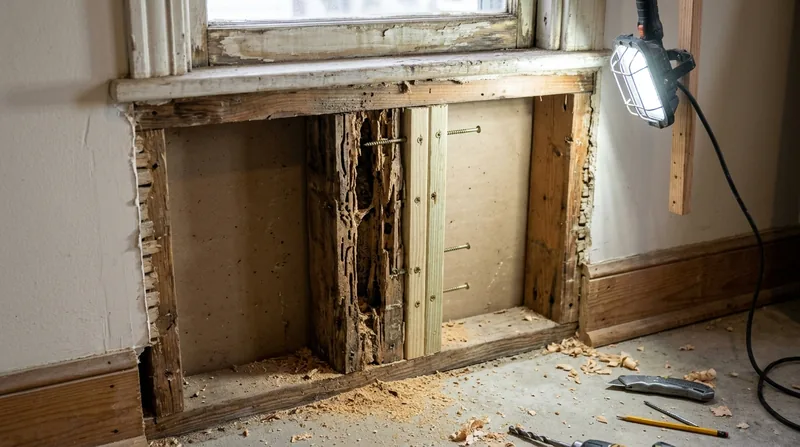




Termite Damage Repair in Grand Rapids means opening walls, removing hollowed studs and sills, and replacing them with solid lumber. In West Michigan, carpenter ants drawn to damp framing are the more common wood-boring pest, but Eastern subterranean termites do appear in older homes near the Grand River. The damage they leave behind looks similar: galleries through the wood grain, structural softness, and a need to stop the moisture that let them in. We identify the compromised framing, remove it, install new lumber, and correct the leak or humidity source so the problem does not return. This work is structural carpentry, and it matters because a hollowed floor joist or sill plate can sag, crack plaster above it, and cost thousands more to repair the longer it sits.
Why Termite Damage Repair Matters in Grand Rapids Heritage Homes and New Construction Alike
Grand Rapids sits in the lake-effect snow belt with long snowy winters, humid summers, and severe thunderstorms. Ice dams and snowmelt rot fascia, soffits, sills and porches. Leaks from gutters, roofing, and windows feed moisture into walls and framing. That dampness is exactly what carpenter ants seek, and it is what draws termites. Our oldest neighborhoods, Heritage Hill and East Hills, hold thousands of homes built before 1920, with wood framing now over a century old. Newer developments in Ada, Cascade, Byron Center, and Rockford have their own leak pathways. The longer wood stays wet, the softer it becomes, and the more attractive it is to wood-boring pests.
- Carpenter ants hollow studs and floor joists in damp framing, leaving galleries that weaken the wood over months or years.
- Termites work more slowly but can compromise large areas of subfloor and sill plate if moisture persists.
- Wet wood in crawl spaces, rim joists, and sill plates is the highest-risk zone because it is hard to see and easy to ignore.
- A single leak from a window, gutter, or roof can feed pest damage for years if the source is not found and fixed.
- Structural damage to floor joists, beams, or sill plates can cause sagging floors, cracked drywall, and doors that no longer close square.
These are the reasons we open the wall, assess the full extent of the damage, and replace only the wood that is truly compromised.
Key info: Most homeowners discover termite or carpenter ant damage during a home inspection or when they notice a soft spot in the floor or a musty smell in a basement. If you have a pest inspection report, bring it with you. We work from that report and repair the wood damage it describes. Pest treatment itself is a separate licensed trade, and we do not offer it. What we do is remove the damaged wood and replace it with sound lumber.
For more on wood-boring pest damage and how it compares to dry rot from general moisture, see our wood rot repair page.
How We Repair Termite Damage: Step by Step in Grand Rapids Homes
Termite and carpenter ant damage is not always obvious from outside. A wall may look fine, but the stud inside may be soft. We start by locating the damage, opening the wall if needed, and measuring how much wood is actually compromised. Then we remove the damaged sections, sister new lumber to the good wood, or replace the whole stud, joist, or sill plate. We always find and fix the moisture source, whether it is a leaky window, a clogged gutter, a cracked foundation, or a plumbing line that sweats in summer humidity.
- We inspect the affected area, probe the wood, and determine which studs, joists, or sill plates need to come out.
- We open the wall carefully, protecting the interior finish and any wiring or plumbing in the cavity.
- We remove the damaged wood and install new pressure-treated or solid lumber, sized to match the original member.
- We correct the moisture source, whether that means sealing a window, cleaning a gutter, or directing water away from the foundation.
- We close the wall, patch the drywall, and restore the interior finish to match the surrounding room.
- We inspect the repair and walk you through what we found, what we fixed, and what to watch for in the future.
The goal is to stop the damage and restore the structural integrity of the framing so your home sits solid and square again.
Local example: A homeowner in East Grand Rapids noticed her kitchen floor sagging near the sink. A pest inspector found carpenter ants in the rim joist. We opened the wall, found four feet of hollowed rim joist and two compromised floor joists, removed and replaced them, sealed the window leak above, and installed a drip edge to shed water away from the wall. The floor is now level, the ants are gone, and the moisture source is fixed. Total time on site, three days. Cost, $3,800.
For details on how we handle larger structural framing repairs, see floor joist and subfloor repair.
Repair Methods and Approaches for Termite Damage
| Approach | Description | Best for |
|---|---|---|
| Stud or joist replacement | Remove the entire damaged member and install new lumber, sistered or full-length as the damage dictates. | Damage to a single stud, floor joist, or rim joist that spans less than half the member's length. |
| Sistering | Bolt or nail a new piece of lumber alongside the damaged member to restore load-bearing capacity. | Partial damage to a joist or beam where the good wood can carry half the load while we install the sister piece. |
| Sill plate replacement | Remove and replace the sill plate, the horizontal member that sits on the foundation and anchors the wall framing. | Damage to the sill from termites or from water wicking up the foundation, especially in basements and crawl spaces. |
| Subfloor replacement | Remove the damaged subfloor sheathing and install new plywood or tongue-and-groove boards. | Widespread termite galleries in subfloor, especially in kitchens and bathrooms where leaks are common. |
| Moisture control and sealing | Repair the leak or moisture source, install a drip edge, seal cracks, or improve drainage to prevent future pest damage. | All termite damage repairs, because stopping the moisture is what stops the pests and prevents the damage from returning. |
Termite Damage Repair Cost in Grand Rapids: What to Expect
A small termite damage repair, such as replacing one hollowed floor joist or a short section of rim joist, typically starts at $1,200 to $1,800. Larger jobs that involve multiple joists, subfloor replacement, or sill plate work can run $2,500 to $5,000 or more. The main factors that affect cost are the extent of the damage, how much wood needs to come out, access to the framing, and whether the moisture source is easy or difficult to fix. A leak in a basement rim joist is often easier to reach than damage in a first-floor rim joist behind a finished wall. A single stud in an exterior wall costs less to replace than four joists in a crawl space with poor access.
The best way to know your cost is to get a free estimate. We will come to your home, open the wall if needed, assess the damage, and give you a firm price before we start work. Most estimates take 30 to 45 minutes and involve no obligation. We can also help you document the damage for an insurance claim if the cause is covered under your homeowner policy.
For a detailed breakdown of our pricing across all carpentry services, see our full pricing page.
Termite Damage Repair Near Me: What to Look for When Hiring a Carpenter in Grand Rapids
When you are looking for a carpenter to repair termite damage, start with the basics. Make sure the contractor is fully insured and can show you a current certificate of insurance. Ask for references from past jobs in your neighborhood, and call at least two of them. A good contractor will walk you through the damage, explain what needs to come out and why, and tell you upfront if a permit is required. In Grand Rapids, structural work such as replacing floor joists or removing a load-bearing wall may require a permit from the city building department. Your contractor should know the local rules and help you navigate them. If you live in a historic district such as Heritage Hill or in a neighborhood with HOA rules, check those restrictions before you start work.
- Ask the contractor to explain the damage in plain language, not in jargon that leaves you confused.
- Get at least two estimates so you can compare scope, materials, and price.
- Verify that the contractor is fully insured and ask to see proof of coverage.
- Check references from recent jobs in your area, and ask about timeline and any surprises that came up.
- Confirm whether a permit is required for your job and who will pull it.
- Ask about the warranty on the repair and what happens if the damage returns.
A carpenter who takes time to answer your questions and explain the work is usually a good sign. We are happy to answer questions and give you a free estimate. Call us at (616) 504-6094 or visit our contact page to request an estimate today.
Termite Damage Repair in Grand Rapids: Pricing Guide
| Service | Price | Details |
|---|---|---|
| Single joist or stud replacement | Starting at $1,200 | Includes removal of damaged member, new lumber installation, wall closure, and moisture source correction |
| Sill plate or rim joist repair | Starting at $1,800 | Removal and replacement of compromised sill or rim, including foundation seal and drainage improvement to prevent recurrence |
| Multiple joists or subfloor damage | Starting at $2,500 | Extensive framing replacement in crawl spaces or basements, including subfloor sheathing and complete moisture remediation |
| Complex or large-scale termite damage | On estimate | Damage spanning multiple structural members or difficult access requires on-site inspection to determine scope and cost accurately |
| Travel and estimate | Free | No charge for the estimate visit or travel within Grand Rapids and surrounding service areas, response within 24 hours |
Indicative pricing, the exact cost depends on square footage, finish, and site access. Free personalized estimate within 24h at (616) 504-6094.


